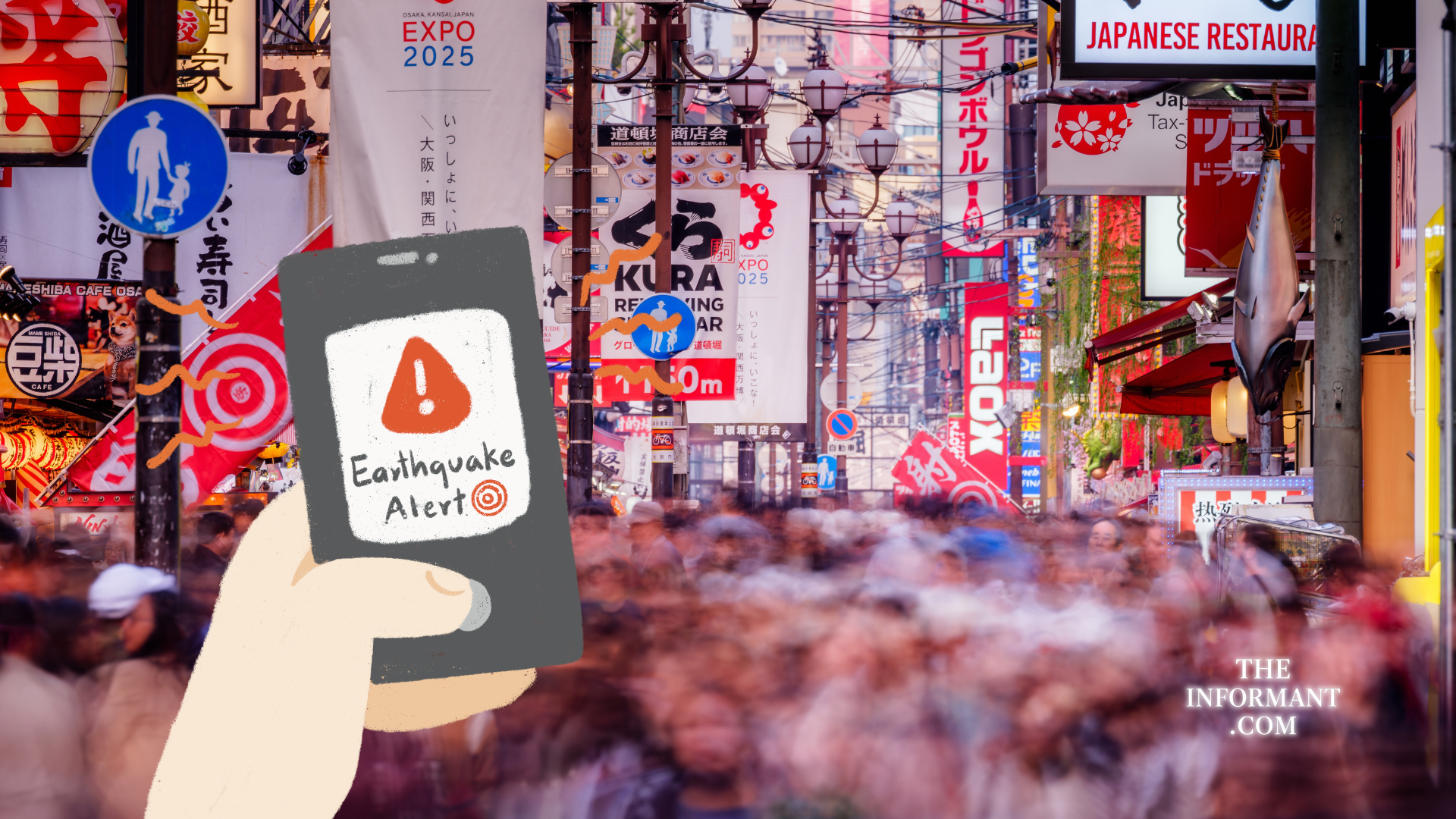
Millions of people across Japan received an extraordinary emergency warning Friday telling them to prepare for potentially catastrophic earthquake shaking. Eight minutes later, the warning was canceled: the estimated magnitude 9.9 earthquake did not exist.
Japan’s Meteorological Agency issued the emergency earthquake warning at about 12:40 p.m. local time on October 16, 2026, covering a broad area from Hokkaido through parts of central Japan. The automated system had calculated a magnitude of 9.9 near the Kuril Islands, large enough to exceed the strongest earthquake ever instrumentally recorded.
What actually happened was far less severe. A magnitude 6.9 earthquake struck near Russia’s Kamchatka Peninsula, producing only weak shaking in Japan. Jiji Press reported that the strongest observed intensity in Japan was just 1 on the Japanese seismic intensity scale in Hakodate, Hokkaido. No destructive shaking followed the emergency alert.
At approximately 12:48 p.m., JMA withdrew the warning and later apologized for the disruption. The agency said the alert system had dramatically overestimated both the earthquake’s location and magnitude. Officials found that a calculation designed for domestic earthquakes had been applied to an event extremely far from Japan and that inconsistent hypocenter information was used during the automated processing.
The false warning still produced real-world consequences. Emergency alerts sounded on mobile phones and public systems, while the Tokaido Shinkansen automatically cut traction power and temporarily stopped trains between Shin-Yokohama and Toyohashi. Services resumed after roughly 15 minutes. JMA said it was continuing to determine exactly why the processing failure occurred.
🚨🇯🇵 JAPAN ISSUES M9.9 MEGAQUAKE ALERT — THEN CANCELS IT 8 MINUTES LATER
— THE INFORMANT (@TheInformantUSA) October 16, 2026
Japan’s Meteorological Agency accidentally warned of a magnitude 9.9 earthquake on October 16, 2026, triggering emergency alerts across a wide area and temporary transportation disruptions. The warning was… pic.twitter.com/KZJLuPa4Y1
The alarm also reached the Tokyo metropolitan region. Social-media video reported by international outlets appeared to show visitors at Tokyo Disney Resort reacting to earthquake warnings and preparing for possible shaking. The resort is located in Urayasu, Chiba Prefecture, immediately east of Tokyo. The available footage supports that precautions were taken, but Tokyo Disney Resort had not issued a separate statement confirming that the parks formally entered an official “emergency mode.”
By later Friday, the resort’s official information showed Tokyo Disneyland operating on its regular 9 a.m. to 9 p.m. schedule, with the Disney Resort Line running normally. There was no indication on its public operations page of a continuing earthquake-related closure.
JMA said there was no indication that a cyberattack caused the error. The agency’s early-warning network remains operational while engineers investigate what went wrong. The incident illustrates the difficult tradeoff built into earthquake early-warning systems: alerts must be generated within seconds, often before enough seismic data exists to produce the more accurate calculations available minutes later.