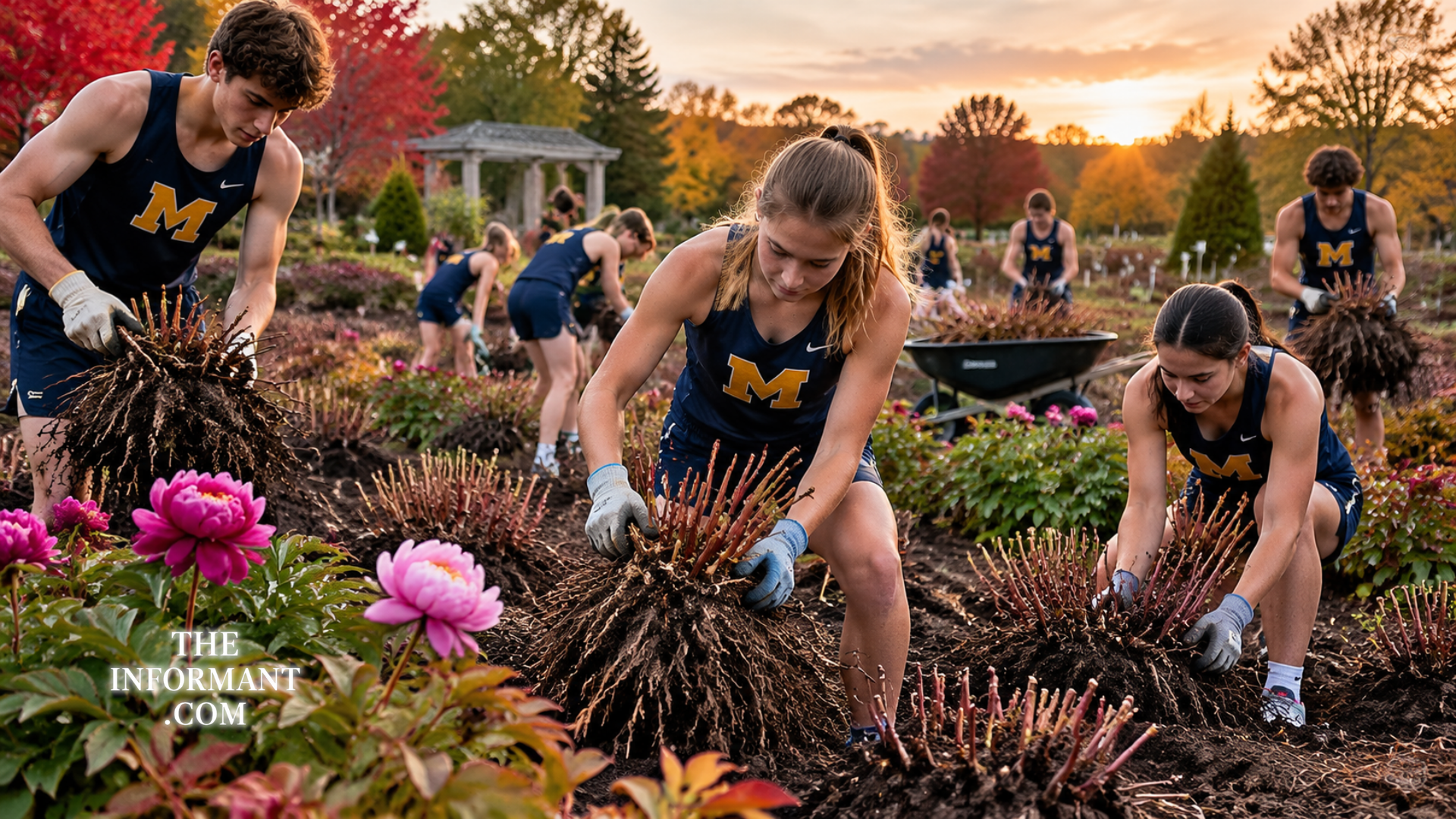
ANN ARBOR, MICHIGAN — October 20, 2026. At the University of Michigan, some of the work that makes spring beautiful happens long before the first flowers appear. Members of the school’s men’s and women’s cross-country teams spent Sunday, October 18, helping prepare one of the campus’s most treasured gardens for winter, completing a task that would normally take considerably longer with a much smaller crew.
Their destination was the W.E. Upjohn Peony Garden at Nichols Arboretum, a historic collection of nearly 800 peony plants. Working together, the student-athletes cut back the seasonal foliage and cleared away the debris in about an hour, giving the plants a clean start as they enter their dormant period.
A HISTORIC GARDEN WITH THOUSANDS OF SPRING BLOOMS
The garden is known for its collection of peonies developed during the 19th and early 20th centuries, representing varieties from Asia, Europe and North America. When the plants reach peak bloom in May and June, the display can feature approximately 10,000 flowers, attracting tens of thousands of visitors to the Ann Arbor campus. The garden is part of the university’s Nichols Arboretum and serves as both a public attraction and a living collection of historic plants.
WHY THE FALL CLEANUP MATTERS
Once the flowering season ends, peonies enter a period of dormancy. Removing their old foliage in autumn is an important part of preparing them for winter and reducing the risk of diseases carrying over into the next growing season. The work may look like a simple garden cleanup, but it helps protect a collection that takes months to reach its spring display.
Olivia Liebing-Slater, the collections horticulturist at Nichols Arboretum, said the annual volunteer effort is an important part of preparing the garden for the following year. Having a large group work together allows the garden staff to complete the task quickly while keeping the plants in good condition.
A CROSS-COUNTRY TRADITION BUILT ON TEAMWORK
The volunteer effort began through longtime women’s cross-country coach Mike McGuire, who has been running through the arboretum since his own days as a Michigan student in the 1970s. Over time, the seasonal cleanup became a recurring team activity, bringing runners together for a task that requires coordination, steady work and plenty of hands.
For Penelopea Gordon, a graduate student on the women’s team, the cleanup was already a familiar tradition. She took part for the fourth time this year and described the work as an opportunity for teammates to rely on one another outside their usual athletic responsibilities. The event also offered a different way for student-athletes to contribute to the campus community.
FRESHMAN RUNNER FINDS A DIFFERENT KIND OF CHALLENGE
Kenny Champ, a first-year runner from Barrie, Ontario, joined the effort for the first time. Rather than racing opponents, he focused on collecting armfuls of cut foliage and carrying the debris to a waiting truck. His personal challenge was to keep increasing the amount he could move with each trip.
The garden’s horticultural staff welcomed the extra help, which turned a substantial seasonal job into a short, coordinated operation. The work also gave newer athletes a chance to take part in a tradition that connects the team with the university’s broader community.
PREPARING TODAY FOR NEXT SPRING’S DISPLAY
The cleanup is a reminder that maintaining a celebrated garden requires work long after its flowers disappear. By removing the aging foliage and clearing the beds before winter, the runners help prepare the nearly 800 plants for another growing season.
When visitors return to Nichols Arboretum next May and June, the garden is expected to once again draw crowds hoping to see its colorful blooms. For the Michigan athletes, Sunday’s effort was a small investment in that future display—and a practical example of how teamwork can make a difference far beyond the finish line.