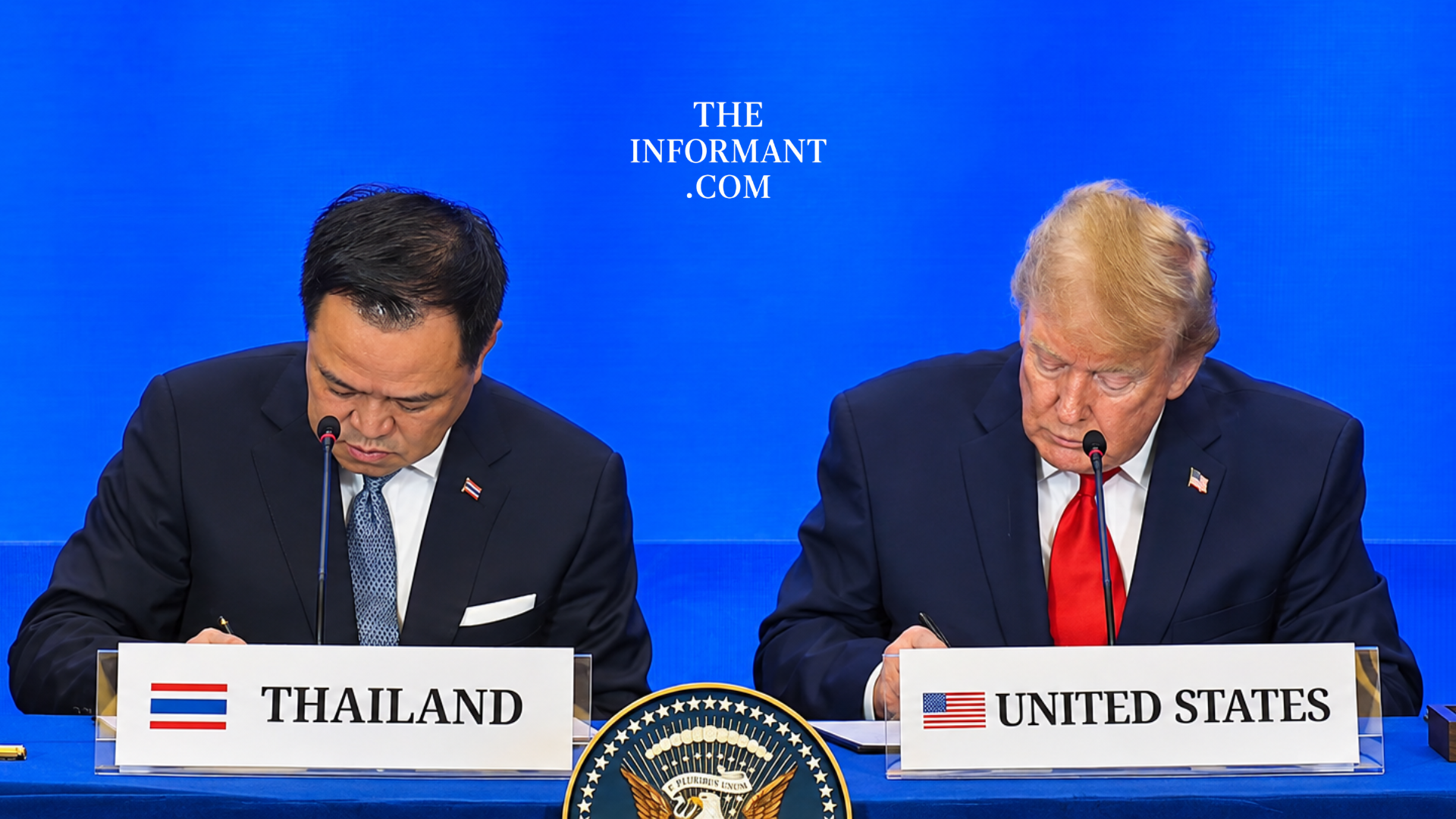
MANILA, PHILIPPINES — November 17, 2026. President Donald Trump and Thai Prime Minister Anutin Charnvirakul signed a joint statement Tuesday confirming that the United States and Thailand have substantially concluded negotiations on a reciprocal trade agreement. The proposed pact would eliminate Thai tariffs on American exports, remove significant regulatory barriers affecting U.S. products and support an estimated $2.6 billion in annual purchases of American agricultural goods. The announcement came during Trump’s visit to Manila for regional diplomatic meetings, marking an important milestone in trade negotiations between Washington and Bangkok.
The agreement, however, is not yet legally finalized. The document signed by the two leaders confirms progress toward a formal Agreement on Reciprocal Trade, known as the ART. Both governments must complete additional internal procedures before the final agreement can be signed and enter into force.
TRUMP AND THAI PRIME MINISTER SIGN JOINT STATEMENT IN MANILA
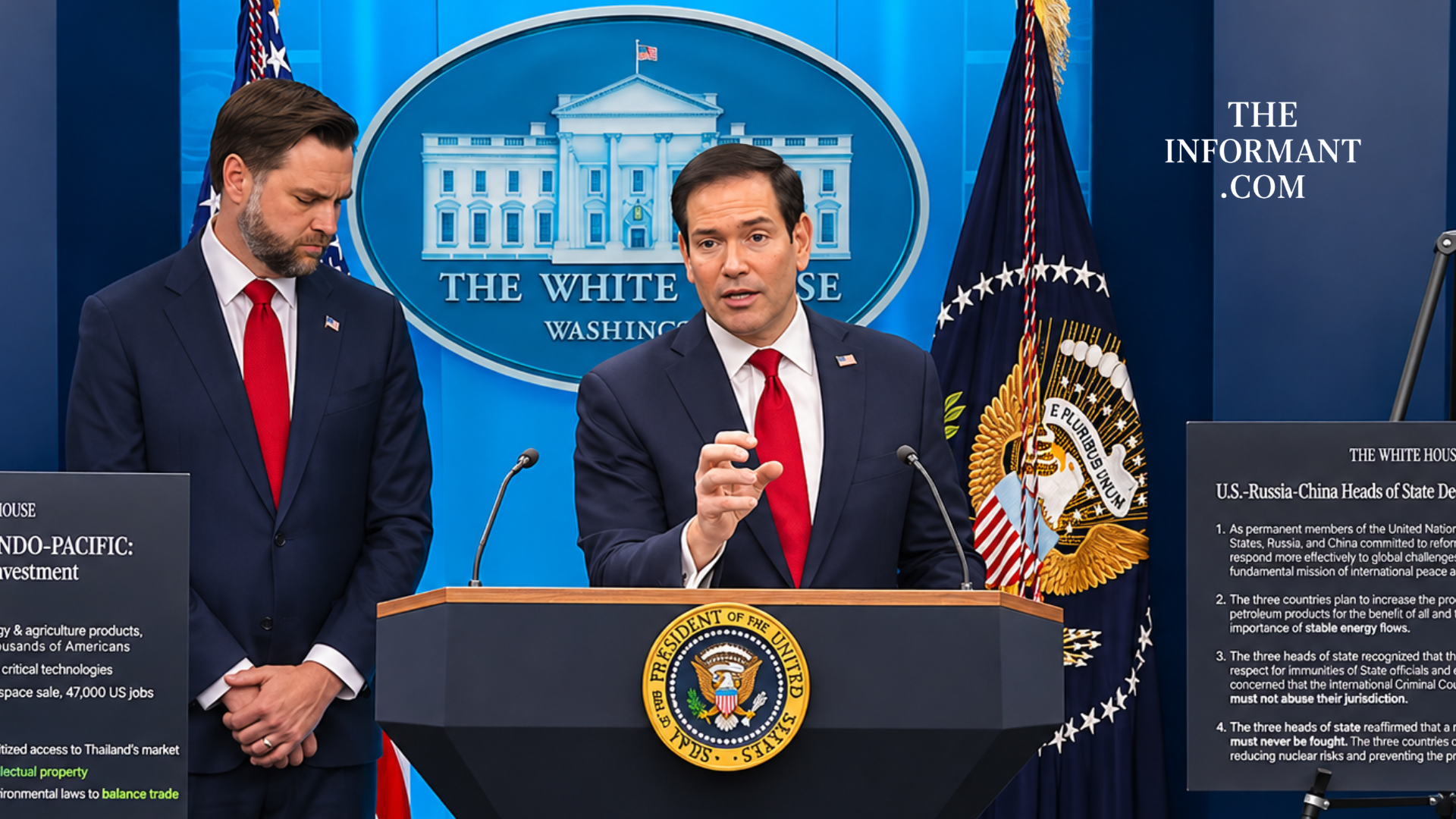
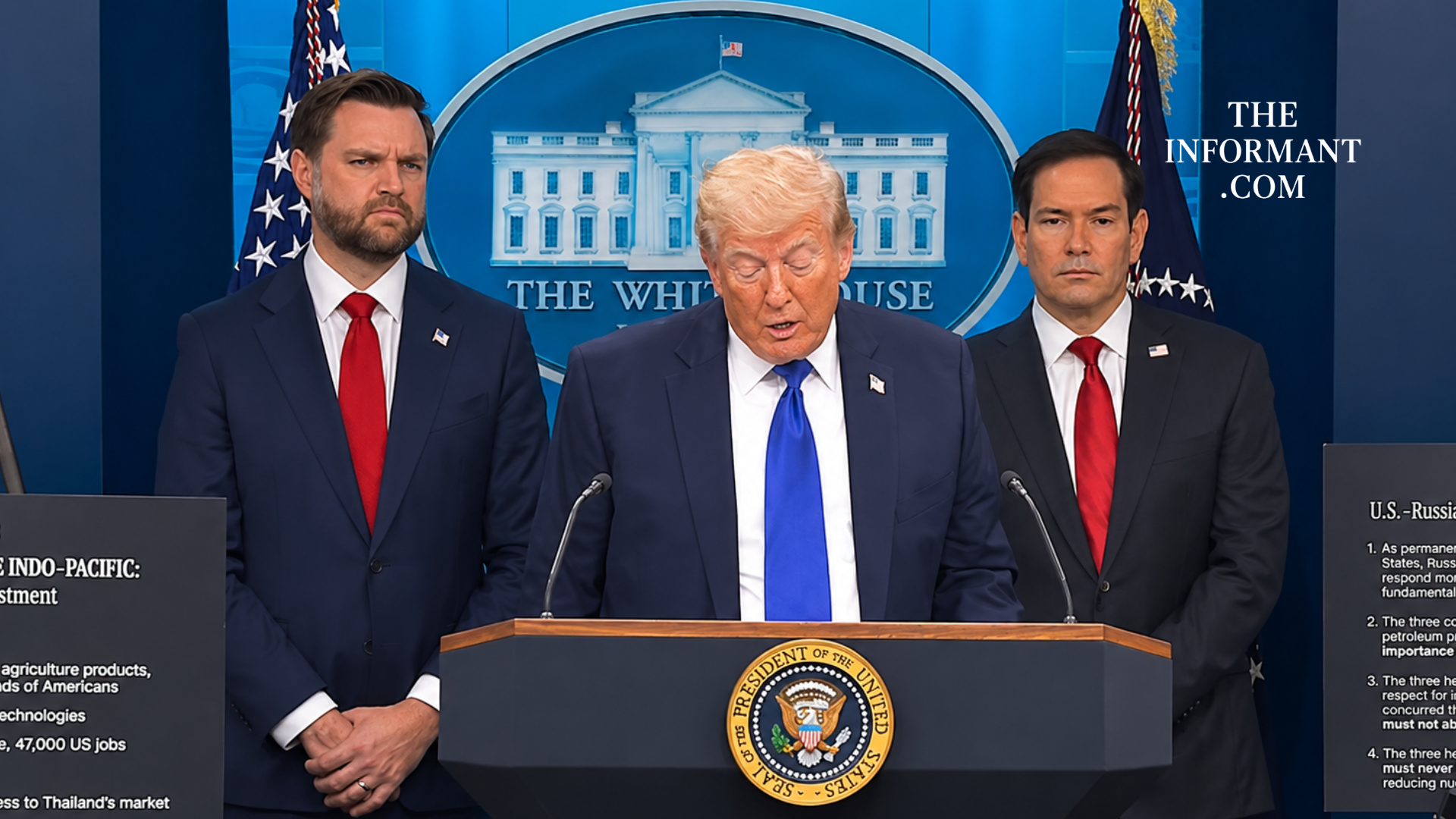
Trump and Anutin appeared together in Manila on November 17 to announce that negotiations had reached a substantial conclusion. The joint statement was published by the White House and signed by both leaders, confirming their governments’ intention to move toward a comprehensive reciprocal trade agreement.
The document describes the proposed pact as an effort to strengthen economic relations between the two countries. It builds on longstanding commercial ties, including the 1966 Treaty of Amity and Economic Relations and the 2002 Trade and Investment Framework Agreement.
The signing represents a diplomatic breakthrough, but the document itself is not the final trade agreement. The United States and Thailand must still complete the procedures required under their respective legal systems before the new provisions can take effect.
THAILAND EXPECTED TO ELIMINATE TARIFFS ON U.S. EXPORTS
One of the most significant provisions announced by Trump is Thailand’s planned elimination of tariffs on American exports. The president described the measure as a major achievement for U.S. businesses seeking greater access to the Southeast Asian market.
The proposal follows an earlier framework announced in October 2025, under which Thailand committed to eliminating tariffs on approximately 99% of U.S. goods. That framework covered a broad range of industrial, food and agricultural products.
Trump’s November 17 announcement went further by describing the intended outcome as the removal of all Thai tariffs on U.S. exports. The precise scope, exemptions and implementation timetable will depend on the final agreement.
Until that agreement enters into force, the announcement should not be interpreted as confirmation that every American product already enters Thailand duty-free.
$2.6 BILLION IN AGRICULTURAL PURCHASES FOR AMERICAN FARMERS
The proposed agreement also includes an estimated $2.6 billion in additional annual purchases of U.S. agricultural products. Trump highlighted the commitment as a potential benefit for American farmers and agricultural exporters.
The agricultural products identified in the earlier bilateral framework include feed corn, soybean meal and dried distillers grains with solubles. These commodities are used extensively in livestock feed and other agricultural supply chains.
The $2.6 billion figure was already included in the October 2025 framework, which described anticipated annual commercial purchases between American and Thai companies. Tuesday’s announcement reinforced that commitment as part of the broader negotiations.
The figure represents a planned commercial value, not proof that all purchases have already been completed or that the full amount has been paid to American producers.
U.S. VEHICLES, MEDICAL DEVICES AND PHARMACEUTICALS COULD BENEFIT
Beyond tariffs, Trump said Thailand would remove significant non-tariff barriers affecting American vehicles, medical devices, pharmaceuticals, ethanol and poultry.
Non-tariff barriers can include licensing requirements, technical standards, import procedures and other regulatory conditions that influence whether foreign products can enter a market. Such requirements are not necessarily tariffs, but they can affect the cost and difficulty of exporting goods.
Reducing these obstacles could create opportunities for American manufacturers and agricultural producers. However, the extent of any benefit will depend on the final provisions and how Thai authorities implement the agreed changes.
The November 17 joint statement did not publish a complete schedule of regulatory changes, product-specific requirements or deadlines.
WHY THE U.S.–THAILAND TRADE RELATIONSHIP MATTERS
Thailand is one of Southeast Asia’s largest economies and an important participant in international manufacturing and agricultural trade. Its commercial relationship with the United States includes electronics, machinery, automotive components, agricultural commodities and consumer products.
According to Reuters, the United States accounted for approximately 24.6% of Thailand’s exports so far in 2026, making it the country’s largest export market.
This dependence gives trade negotiations significant importance for Thai exporters, particularly those whose products face U.S. import duties. At the same time, American businesses are seeking expanded access to Thailand’s domestic market.
The proposed agreement is intended to address these interests through a combination of tariff reductions, market-access commitments and additional commercial transactions.
TRADE IMBALANCE REMAINS CENTRAL TO TRUMP’S POLICY
Trump’s administration has repeatedly emphasized bilateral trade imbalances as a justification for reciprocal tariff negotiations. The administration argues that reducing foreign trade barriers can improve opportunities for American producers and exporters.
The claim circulating alongside Tuesday’s announcement refers to a Thai merchandise trade surplus of approximately $71.7 billion with the United States in the previous year. That specific figure requires confirmation against the relevant U.S. government trade dataset and reporting period before being presented as an established statistic.
A bilateral trade deficit or surplus measures the difference between the value of goods traded in each direction. It does not, by itself, establish whether a particular trade relationship benefits or harms an economy.
The potential effects of the proposed agreement will depend on changes in trade flows, consumer prices, investment and business activity after implementation.
WHAT HAPPENS TO U.S. TARIFFS ON THAI GOODS?
The trade negotiations also concern tariffs imposed by Washington on products imported from Thailand.
Under the framework announced in October 2025, the United States planned to maintain a 19% reciprocal tariff on covered Thai goods, with certain products potentially eligible for different treatment.
That arrangement followed earlier negotiations in which Thailand faced the possibility of substantially higher U.S. duties. The reciprocal trade framework sought to establish conditions for continued commercial access while Thailand agreed to open more of its market to American products.
Tuesday’s announcement did not establish that the United States would eliminate all tariffs on Thai exports. The proposed elimination concerns tariffs imposed by Thailand on American products, not necessarily duties applied in the opposite direction.
This distinction is essential for understanding the agreement’s commercial implications.
AGREEMENT ALSO BUILDS ON ENERGY AND AVIATION COMMITMENTS
The October 2025 framework identified additional potential commercial transactions beyond agriculture.
These included estimated annual purchases of $5.4 billion in American energy products, such as liquefied natural gas, crude oil and ethane. The framework also referred to the procurement of 80 U.S. aircraft with an estimated value of $18.8 billion.
These figures formed part of the broader commercial expectations associated with the negotiations. They should not be described as new purchases completed on November 17 without separate confirmation of contracts, deliveries and payment schedules.
The aviation and energy commitments illustrate the breadth of the proposed economic relationship, extending beyond tariffs and agricultural trade.
ANUTIN SAYS FORMAL AGREEMENT COULD BE SIGNED SOON
Prime Minister Anutin Charnvirakul expressed confidence that the final agreement could be signed in the near future. He described the negotiations as an opportunity to strengthen bilateral economic relations and expand opportunities for businesses and other stakeholders.
Thai officials had previously emphasized that the November 17 event would involve a joint statement confirming progress rather than the signature of the complete trade agreement.
The final text must undergo additional legal and domestic review. According to reporting on Thailand’s preparations, these steps may include Cabinet consideration, parliamentary procedures and public consultation.
The timing of the final signature therefore remains subject to the completion of those requirements.
WHAT THE AGREEMENT COULD MEAN FOR AMERICAN BUSINESSES
If implemented as announced, the agreement could improve access to Thailand’s market for American agricultural producers, manufacturers and exporters.
Lower tariffs can make imported products more competitive, while reductions in regulatory obstacles may simplify certain commercial transactions. The expected agricultural purchases could also support demand for U.S. farm commodities.
Nevertheless, the announcement does not establish that the proposed benefits have already materialized. Actual economic outcomes will depend on the agreement’s final terms, purchasing decisions, exchange rates, market conditions and implementation.
Businesses will need to examine the final legal text to determine which products qualify for preferential treatment and when those provisions become effective.
FINAL TRADE AGREEMENT STILL AWAITS SIGNATURE
The November 17 announcement marks an important stage in U.S.–Thailand trade negotiations, with both governments confirming substantial progress and Trump outlining commitments on tariffs, regulatory barriers and agricultural purchases.
The central unresolved issue is when the final Agreement on Reciprocal Trade will be signed and implemented. Until that occurs, the planned elimination of Thai tariffs and the associated market-access changes remain commitments under negotiation rather than fully operative trade rules.
For American farmers and exporters, the announcement creates expectations of greater commercial access to Thailand. For Thai businesses, the final terms will determine how the agreement affects access to the U.S. market and the country’s broader trade relationship with Washington.
The next developments will be the publication of the completed agreement, its approval under the relevant domestic procedures and confirmation of the date on which its provisions enter into force.