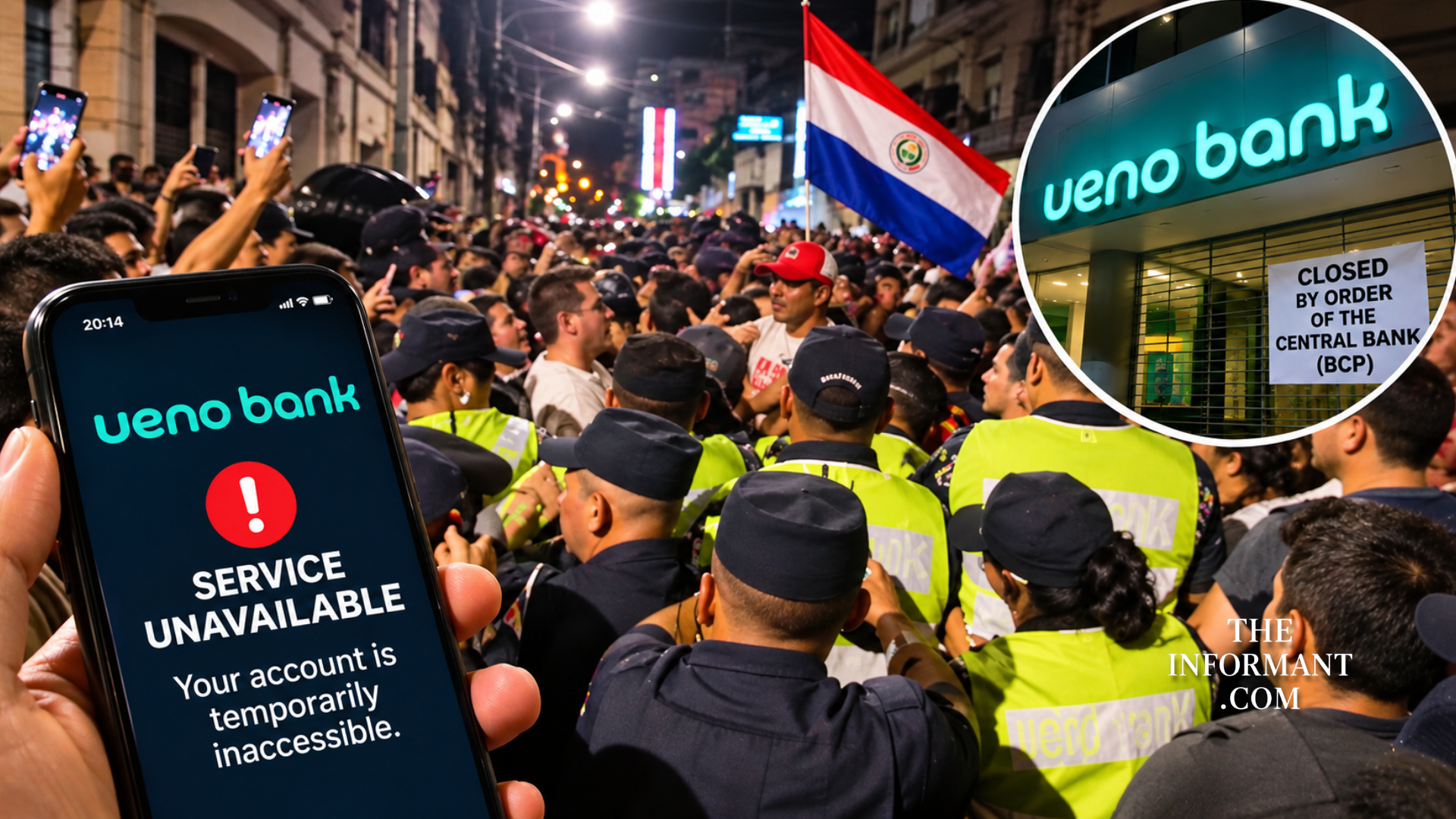
ASUNCIÓN, PARAGUAY — November 5, 2026. Paraguay is facing a major financial and political crisis after the country’s central bank intervened in Ueno Bank, one of its largest digital lenders, following serious concerns about its financial solvency. The intervention has disrupted banking services for customers of an institution that reports approximately three million users, while eight executives have been detained and the central bank’s president has submitted his resignation.
CENTRAL BANK INTERVENES AFTER SOLVENCY CRISIS
The Banco Central del Paraguay (BCP) announced on November 3 that its board had unanimously approved resolution proceedings against Ueno Bank the previous day.
According to the regulator, adjustments to the bank’s financial statements revealed that its solvency ratio had fallen below half the legally required minimum.
The measure places the institution under a formal resolution process intended to protect depositors, assess its financial position and limit risks to the broader banking system.
Regulators had previously raised concerns about lending arrangements involving companies connected to the bank’s owners.
MILLIONS OF CUSTOMERS FACE BANKING DISRUPTIONS
Ueno Bank reports having approximately 2.9 million to three million customers, representing a substantial share of Paraguay’s adult population.
Following the intervention, customers reported being unable to access mobile banking, withdraw money from ATMs or complete ordinary transactions.
The disruption has generated widespread concern among individuals and businesses that rely on the institution for everyday financial services.
However, the total customer count should not be interpreted as a verified number of people who permanently lost their savings.
BREAKING: 🇵🇾 What just happened in PARAGUAY is a WARNING for everyone on earth.
— ADAM (@adamemedia) November 5, 2026
More than 3 million people (60% of Paraguay's adult population) have lost access to EVERYTHING. Their bank accounts. Their pensions. Frozen. Inaccessible.
Paraguay’s largest digital bank, Ueno… pic.twitter.com/Oz8K4w7zlO
EIGHT BANK EXECUTIVES DETAINED
Paraguayan prosecutors ordered the detention of eight people linked to Ueno Bank as part of an investigation involving suspected breach of trust and other possible financial offenses.
Among those detained were Federico Miguel Vázquez Villasanti, a leading figure in the bank’s ownership group, and bank president Juan Manuel Gustale.
Local reporting confirmed that all eight individuals named in the detention orders were in police custody by late November 3.
The investigation remains ongoing, and detention does not establish criminal guilt.
CENTRAL BANK PRESIDENT RESIGNS
The banking crisis also triggered a major change in Paraguay’s financial leadership.
President Santiago Peña requested the resignation of central bank president Carlos Carvallo after questions emerged concerning his previous professional ties to Ueno Bank.
Carvallo submitted his resignation on November 3 but said he would remain during the institution’s resolution process.
The development has intensified political scrutiny of Paraguay’s financial oversight system and the relationship between public officials and private banking interests.
PUBLIC PENSION FUNDS RAISE CONCERNS
One of the most sensitive issues involves public money deposited at Ueno Bank.
Reporting indicates that the institution held approximately $800 million to $850 million in public-sector funds, including roughly $380 million associated with Paraguay’s social security and pension system.
The exposure has raised questions about how public deposits were managed and what safeguards are available to protect them.
The presence of pension-related deposits at the bank does not mean that every pension payment has been permanently lost.
DEPOSIT GUARANTEES AND GOVERNMENT RESPONSE
Paraguay’s deposit guarantee system protects eligible deposits up to 75 monthly minimum wages per depositor at each financial institution.
At the time of the intervention, that represented approximately 228.3 million Paraguayan guaraníes, equivalent to roughly $38,000.
Authorities announced measures to begin partial payments while the resolution process continues.
The government has also sought legislation to accelerate access to funds and reduce the consequences for affected customers.
PROTESTS AND POLITICAL PRESSURE INTENSIFY
The crisis has prompted demonstrations in Asunción and growing criticism of President Santiago Peña’s administration.
Opposition lawmakers have accused the government of failing to adequately supervise the bank and have called for political accountability.
Thirty-five opposition legislators submitted impeachment articles against Peña, although the proposal faces significant parliamentary obstacles.
The president has called for depositors to be protected and for possible financial wrongdoing to be investigated.
WHAT HAPPENS NEXT?
The central bank must continue evaluating Ueno Bank’s assets, liabilities and possible options for transferring deposits or resolving the institution.
Prosecutors are also investigating whether financial irregularities involved criminal conduct.
The immediate priority for affected customers is obtaining reliable information about deposit protection, withdrawal procedures and the restoration of banking access.
The crisis represents a major test of Paraguay’s financial oversight institutions, but authorities have not established that the country’s entire banking system is at risk.