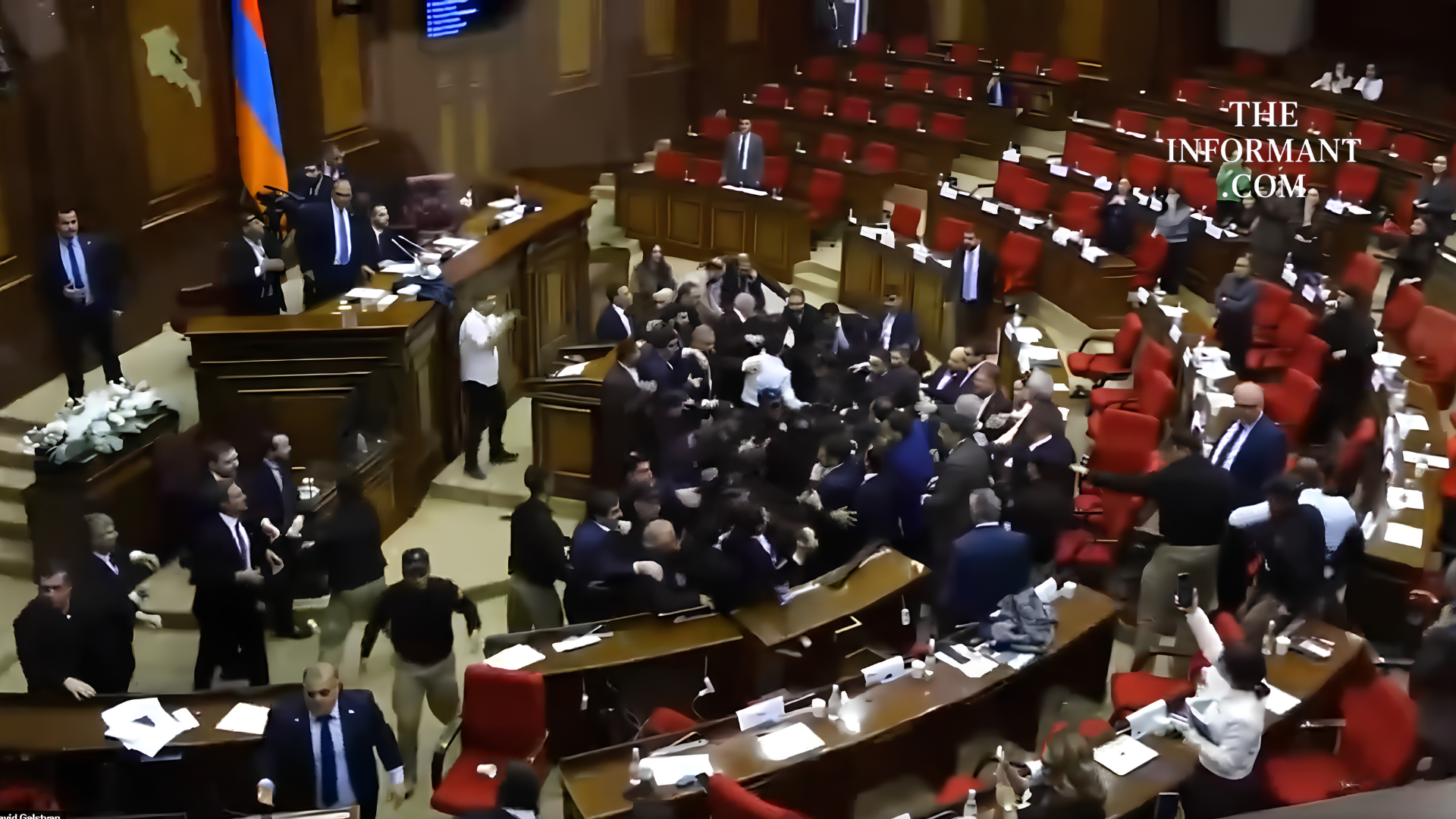
YEREVAN, Armenia — October 29, 2026. A heated political confrontation erupted into a physical brawl inside Armenia’s National Assembly on Thursday, as lawmakers from Prime Minister Nikol Pashinyan’s ruling Civil Contract party and the opposition Strong Armenia faction exchanged punches, pushed one another and threw a chair during a parliamentary session.
The confrontation began after ruling-party lawmaker Taron Chakhoyan made controversial remarks about the family of opposition leader Narek Karapetyan. The dispute escalated into a physical altercation that forced parliamentary security officers to intervene and temporarily suspend proceedings.
CONTROVERSIAL REMARKS TRIGGER PARLIAMENTARY CONFRONTATION
The incident unfolded during a parliamentary debate concerning the appointment of a member of Armenia’s Audit Chamber, the government institution responsible for examining public finances.
Chakhoyan was addressing allegations of corruption involving opposition figures when he turned his criticism toward Karapetyan and his relatives.
The ruling-party legislator referred to a controversial statement previously attributed to one of Karapetyan’s cousins about establishing a government ministry intended to satisfy women.
Chakhoyan questioned why Karapetyan’s political allies had not apologized for the earlier remark.
Karapetyan responded angrily from his seat, prompting a verbal confrontation that quickly drew other lawmakers into the dispute.
LAWMAKERS EXCHANGE PUNCHES INSIDE NATIONAL ASSEMBLY
As the argument intensified, Karapetyan approached the parliamentary podium while other opposition legislators stood and moved toward the confrontation.
Members of the ruling and opposition factions began pushing and grabbing one another.
The confrontation escalated into punches and kicks, with several lawmakers attempting to separate those involved.
Opposition lawmaker Garnik Davtyan and ruling-party member Taron Chakhoyan were among those involved in the physical altercation.
Video footage from the parliamentary chamber captured lawmakers struggling with one another as the situation deteriorated.
The incident disrupted the legislative session and required intervention by security personnel.
DEPUTY SPEAKER THROWS CHAIR DURING BRAWL
One of the most controversial moments involved Deputy Speaker Vahagn Aleksanyan, a member of the ruling Civil Contract party.
Video footage showed Aleksanyan throwing a chair toward opposition lawmakers during the confrontation.
The incident intensified criticism of the conduct of senior parliamentary officials.
Reports also described damage to property inside the chamber.
At least one opposition lawmaker suffered a bleeding nose, while another reportedly had his clothing torn during the altercation.
An ambulance was dispatched to the parliament building, although the full extent of injuries was not immediately established.
PARLIAMENT SPEAKER INITIALLY REFUSES TO SUSPEND SESSION
Parliament Speaker Ruben Rubinyan initially declined to interrupt proceedings as tensions increased.
He told lawmakers that he wanted the public to witness their behavior and urged them to decide whether they would continue fighting or return to their seats.
As the confrontation intensified, Rubinyan eventually called a recess and summoned parliamentary security officers.
The fighting reportedly continued in the corridors outside the chamber, where security personnel attempted to separate members of the opposing factions.
The speaker later defended his handling of the situation, arguing that he had called for intervention once the dispute became physically violent.
Opposition representatives criticized that explanation and accused him of failing to act quickly enough.
SPEAKER BLAMES OPPOSITION LEADER FOR VIOLENCE
Following the confrontation, Rubinyan publicly blamed Karapetyan and Davtyan for triggering the fight.
The speaker said he had reviewed footage of the incident and concluded that Chakhoyan’s remarks did not contain an offensive statement.
According to Rubinyan, Karapetyan interrupted the speech, directed insults toward the ruling-party lawmaker and approached him aggressively.
Rubinyan also accused Davtyan of throwing the first punch.
The opposition disputed that account and maintained that Chakhoyan’s comments about Karapetyan’s family had provoked the confrontation.
The competing accounts highlight disagreements over responsibility for the violence.
PRIME MINISTER PASHINYAN DEFENDS RULING PARTY LAWMAKERS
Prime Minister Nikol Pashinyan addressed the incident during a press briefing later Thursday.
He condemned violence in general but said he supported the response of lawmakers from his Civil Contract party.
Pashinyan placed responsibility for the confrontation on the opposition, arguing that its representatives had behaved provocatively and refused to apologize for previous remarks.
The prime minister also defended Aleksanyan’s decision to throw a chair, describing the response as proportionate under the circumstances.
His statements prompted additional controversy because they appeared to justify the physical actions of ruling-party legislators.
Opposition representatives rejected his interpretation and accused government officials of encouraging confrontational behavior.
STRONG ARMENIA ACCUSES GOVERNMENT OF PROVOKING FIGHT
Representatives of Strong Armenia argued that the confrontation began with deliberate personal attacks by the ruling party.
Opposition lawmaker Marianna Ghahramanian accused Speaker Rubinyan of allowing the situation to escalate rather than intervening immediately.
Other opposition figures said Chakhoyan’s remarks were intended to provoke Karapetyan during an already contentious debate.
The opposition also criticized the involvement of senior parliamentary officials in the physical confrontation.
Government representatives denied orchestrating the incident and maintained that opposition lawmakers had initiated the violence.
POLITICAL TENSIONS CONTINUE IN ARMENIA
The confrontation comes amid ongoing political disagreements between Pashinyan’s government and opposition parties.
Strong Armenia is associated with businessman Samvel Karapetyan, whose political movement has challenged the ruling party.
The two sides have clashed over corruption allegations, government accountability and Armenia’s political direction.
Thursday’s confrontation took place during discussions concerning the Audit Chamber, reflecting the broader tensions surrounding institutional oversight and public finances.
Armenia has experienced previous parliamentary confrontations, although the use of physical force inside the legislature has repeatedly generated public criticism.
NO CRIMINAL PROCEEDINGS ANNOUNCED IMMEDIATELY
Armenia’s Prosecutor General’s Office said Thursday afternoon that it had no information about criminal proceedings being initiated in connection with the parliamentary fight.
That statement did not rule out a subsequent investigation.
The speaker also indicated that allegations concerning the involvement of parliamentary aides or security personnel would be examined.
Any disciplinary or criminal consequences would depend on further review of the footage, witness statements and applicable parliamentary rules.
WHAT HAPPENS NEXT?
Armenian parliamentary authorities are expected to review the circumstances surrounding the confrontation and determine whether disciplinary measures are warranted.
The incident has intensified tensions between the ruling Civil Contract party and opposition Strong Armenia representatives.
Questions remain about the use of force by lawmakers, the actions of parliamentary security and the speaker’s decision to delay suspending the session.
For now, the video confirms that the dispute escalated into physical violence, while government and opposition representatives continue to disagree over who bears responsibility.
The confrontation raises renewed questions about parliamentary conduct, institutional accountability and the ability of Armenia’s political factions to resolve disputes through legislative debate.