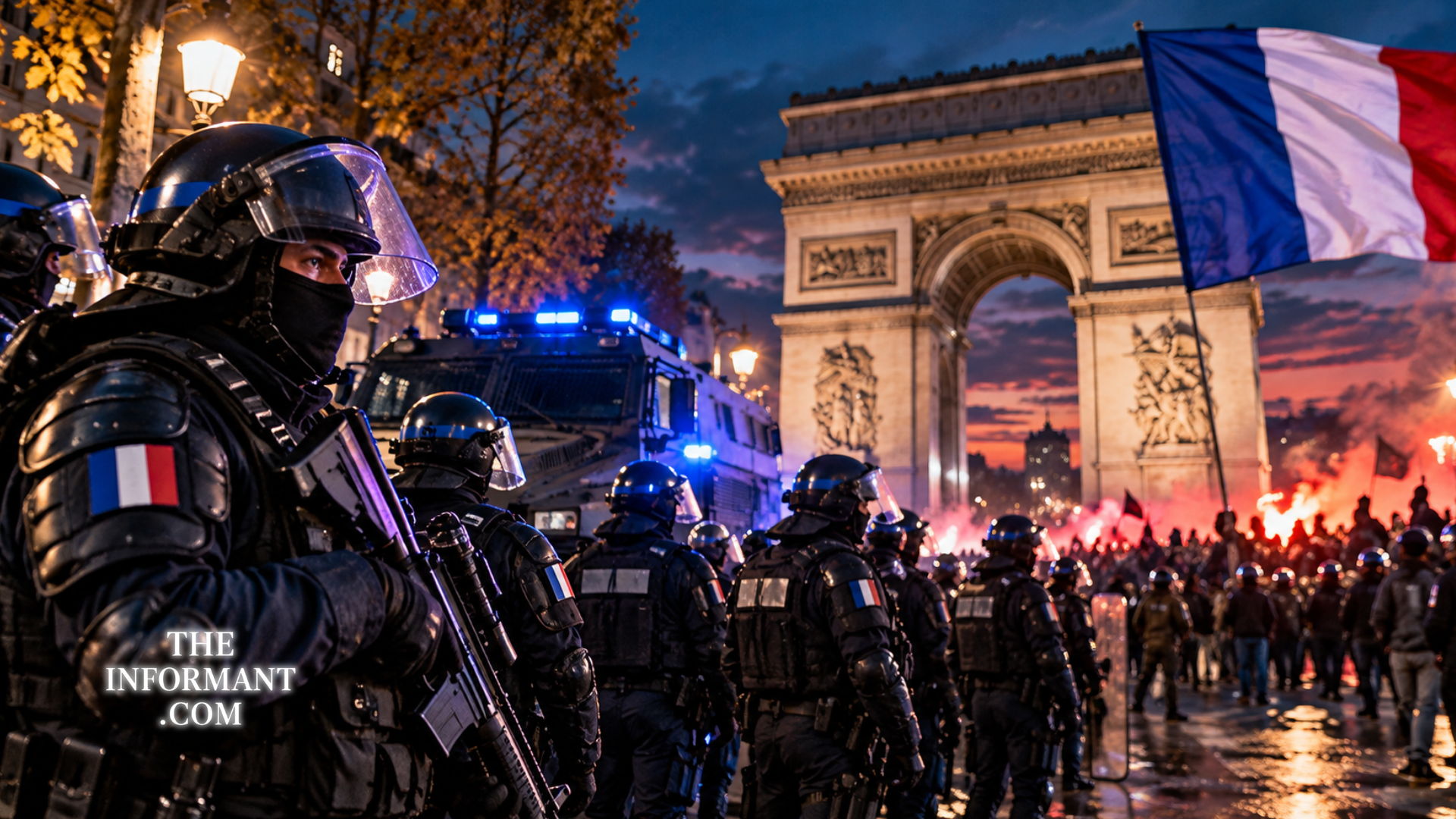
PARIS, FRANCE — October 30, 2026. France is preparing for another major wave of demonstrations on Saturday, October 31, as a growing protest movement over living costs, wages and public services enters its third consecutive weekend. This time, the mobilization coincides with Halloween, prompting the government to announce an exceptional deployment of 70,000 police officers and gendarmes amid concerns that some groups could attempt to exploit nighttime gatherings to trigger violence.
Interior Minister Laurent Nuñez outlined the security operation Thursday, warning that authorities had identified social-media messages encouraging confrontations and attacks on property. The government’s main concern is the period after 8 p.m., when authorized daytime demonstrations are expected to have ended and Halloween celebrations will be taking place. Officials say they are preparing for disturbances that could extend late into the night.
WHY FRANCE IS PREPARING FOR ANOTHER MASSIVE PROTEST
The October 31 demonstrations mark the third consecutive Saturday of nationwide mobilization, following protests on October 17 and 24. What began with student anger over educational conditions has expanded into a broader movement involving labor unions, university students and Yellow Vest activists.
Demonstrators are demanding better wages, stronger public services, additional educational resources and relief from the rising cost of living. Student organizations have also criticized policing tactics used during previous protests. The government has announced measures intended to address some educational concerns, but organizers say the responses remain insufficient.
HALLOWEEN CREATES ADDITIONAL SECURITY CONCERNS
According to Nuñez, authorities detected calls for nighttime gatherings that included messages advocating serious public disorder. He attributed some of these calls to radical far-left networks and certain radicalized Yellow Vest groups.
The minister said prefects would prohibit gatherings assessed as intended to provoke violence. He also warned against using Halloween costumes or face coverings to conceal identities while committing offenses.
The legal distinction is important: French law permits face coverings for genuine festivities, including Halloween. Separate restrictions apply to deliberately concealing one’s face without legitimate justification during demonstrations where public disorder occurs or is considered likely. Wearing a Halloween costume does not automatically constitute an offense.
THE SHADOW OF OCTOBER 17’S VIOLENT UNREST
The heightened security follows serious disturbances during the October 17 demonstrations. Groups engaged in vandalism, looting and confrontations with police in several French cities, damaging public buildings and commercial properties.
In Limoges, the historic city hall suffered extensive damage in a fire during the unrest. Local authorities subsequently launched emergency measures to secure the remaining structure and maintain municipal services.
French government officials said at least 3,000 businesses experienced damage or looting during that period, generating substantial pressure on the administration to prevent similar incidents.
SECURITY FORCES, DRONES AND SPECIALIZED UNITS PREPARED
The government plans to deploy approximately 70,000 police officers and gendarmes nationwide, matching the staffing level used on October 24. The operation includes mobile public-order units, specialized police teams and equipment such as helicopters, drones and armored gendarmerie vehicles.
Authorities have also planned protective measures around commercial districts, government buildings and other locations considered vulnerable. In certain areas, nighttime curfews and restrictions on unauthorized gatherings have been introduced.
Officials maintain that the measures are intended to protect residents and businesses while allowing peaceful demonstrations to proceed.
PARIS PROTEST ROUTES BECOME A LEGAL BATTLEGROUND
In Paris, unions initially requested permission to march from Place de la Bastille to Place de la Nation, while Yellow Vest organizers proposed another route toward Place de la Concorde.
The police prefecture rejected the proposed central routes and designated an alternative procession along the eastern edge of the capital, from Porte de Bagnolet to Porte de Charenton.
Union representatives challenged the restrictions, arguing that moving demonstrations away from central Paris would weaken their ability to make their demands heard. The authorities defended their decision as necessary to reduce risks to businesses, public infrastructure and people traveling through the city.
Later Friday, reports indicated that an administrative court had suspended the restriction on the unions’ Bastille-to-Nation route. The Interior Ministry indicated that authorities intended to appeal. The final arrangements remain subject to further legal and administrative developments.
PROTESTERS TURN TO OFFLINE MESSAGING TECHNOLOGY
The preparations have also highlighted growing interest in Bitchat, a messaging application that allows nearby users to exchange communications through Bluetooth-based networks without requiring conventional internet or mobile service.
French media reported a surge in downloads as the demonstrations approached. The technology may offer an alternative communication channel when mobile connectivity is unavailable or disrupted.
However, increased downloads do not by themselves establish that the application is being used to organize criminal activity. The motivations and behavior of individual users cannot be inferred solely from the platform’s popularity.
TWO VERY DIFFERENT ESTIMATES OF PROTEST TURNOUT
The scale of the movement remains a point of disagreement. France’s Interior Ministry counted 410,000 demonstrators across the country on October 24, including 110,000 in Paris. The CGT labor union estimated approximately 800,000 nationally and 250,000 in the capital.
These are competing estimates for the same protest day, not figures that should be combined. Government data recorded 550,000 participants in the earlier October 17 demonstrations.
The October 31 turnout has not yet been measured. Organizers hope to sustain the movement, while the government is preparing for another large-scale mobilization.
WHAT FRANCE FACES ON HALLOWEEN NIGHT
The demonstrations bring together two competing public concerns: the right to peaceful assembly and the need to protect communities from violence and property damage.
For labor and student organizations, Saturday represents another opportunity to pressure the government over economic and social demands. For security officials, preventing the recurrence of October 17’s destructive incidents is the central operational objective.
Attention will turn to the actual number of protesters, any confrontations between demonstrators and police, the outcome of court challenges to restrictions and the nationwide strike called for November 5.
As Halloween approaches, the crucial question is whether France can accommodate another major day of political protest while preventing the nighttime unrest that officials fear.